Skip to content

Press conferences

Press conferences every journalist can follow live

Baian provides AI live interpretation for press conferences, translating the spokesperson’s statement and questions that reach the audio feed. Journalists read or listen on their phones. Organisers can replace agreed interpreter channels without booths or receiver distribution.

How far behind the speaker?About 2.4 seconds with Baian. Lower is better.

How often Baian was preferredOver professional translations · English into each language

  • Arabic 58%preferred
  • Hindi 65.5%preferred
  • Korean 61.5%preferred

The line marks 50%: an even split.

Estimates; interpreter timing comes from a separate study. Sources and methods

On their own phones

What do attendees get?

Press-room access
Journalists’ own phones and headphones
Questions
The question microphone must reach Baian
Broadcast text
Camera Overlay as an OBS Browser Source
Illustration. Attendees see the languages you choose for the event.

Against interpreters

What can’t a booth do?

  • No breaks

    BaianRuns for the whole session.

    InterpretersSwap about every 30 minutes.

  • Doesn’t tire

    BaianNo fatigue, however long it runs.

    InterpretersIn one study, meaning errors rose after 30 minutes.

  • Sentence-by-sentence translation

    BaianBuilt to translate the speech, not summarise it.

    InterpretersIn one study, omitted meaning in 350 of 590 segments.

  • Many languages at once

    BaianSeveral languages from one stage feed.

    InterpretersOne interpreter team per language.

  • A saved transcript

    BaianThe speech and each translation, saved.

    InterpretersSeparate transcription needed.

  • Listen back

    BaianDownload the translated audio afterwards.

    InterpretersOnly if someone records the booth.

For your AV team

Where can the translation go?

Phones, venue screens, your livestream or an existing headset system, all from one stage feed. A transcript is saved afterwards.

Connection guide for AV teams
Your sound deskOne stage feed
  • Audience phonesRead or listen after scanning a QR code.
  • Venue screensLive captions on a projector or LED wall.
  • LivestreamA caption overlay for OBS.
  • Headset systemTranslated audio through an audio interface.
  • TranscriptThe whole session, saved afterwards.

Planning your event

What should you plan for?

Whispered interpretation and equipped press seats

UN Geneva occasionally uses whispered interpretation for press conferences and high-level private bilateral meetings, serving a very limited audience with or without mobile equipment. Decide whether your briefing needs that small-group format or language channels for the full press room.

The European Council’s arrangements for 24 and 25 June 2021 specified interpretation in English, French, German and Portuguese. Its November 2017 press-centre rules give journalists priority for seats with interpretation headphones. Plan the seats and language access for your own briefing.

Give journalists the right language channel

Baian can replace agreed interpreter channels with translated text and headphone audio on journalists’ phones. For government briefings, the organiser decides whether certified human interpretation is required. If both services operate, identify which languages each supplies in the press information.

Journalists can read the translation while following the statement or choose audio through their headphones. Make the session link visible to people arriving after the briefing has started.

Follow the microphone from podium to journalist

Rehearse a journalist’s question as well as the spokesperson’s answer. Check that the roaming question microphone reaches the translation feed. Enable Multiple spoken languages before the session starts if the supported speaking languages will change, and test names and terms from the statement.

Inspect the briefing’s captioned livestream

Confirm Camera Overlay access with the booking, then add its link to OBS as a Browser Source for livestream captions. Translated audio requires its own route. Review the finished streamed picture during a question, then agree how the chair handles any interruption to interpretation.

Customer story · QIYADA, Doha

Two days. One QR code on the stage screen.

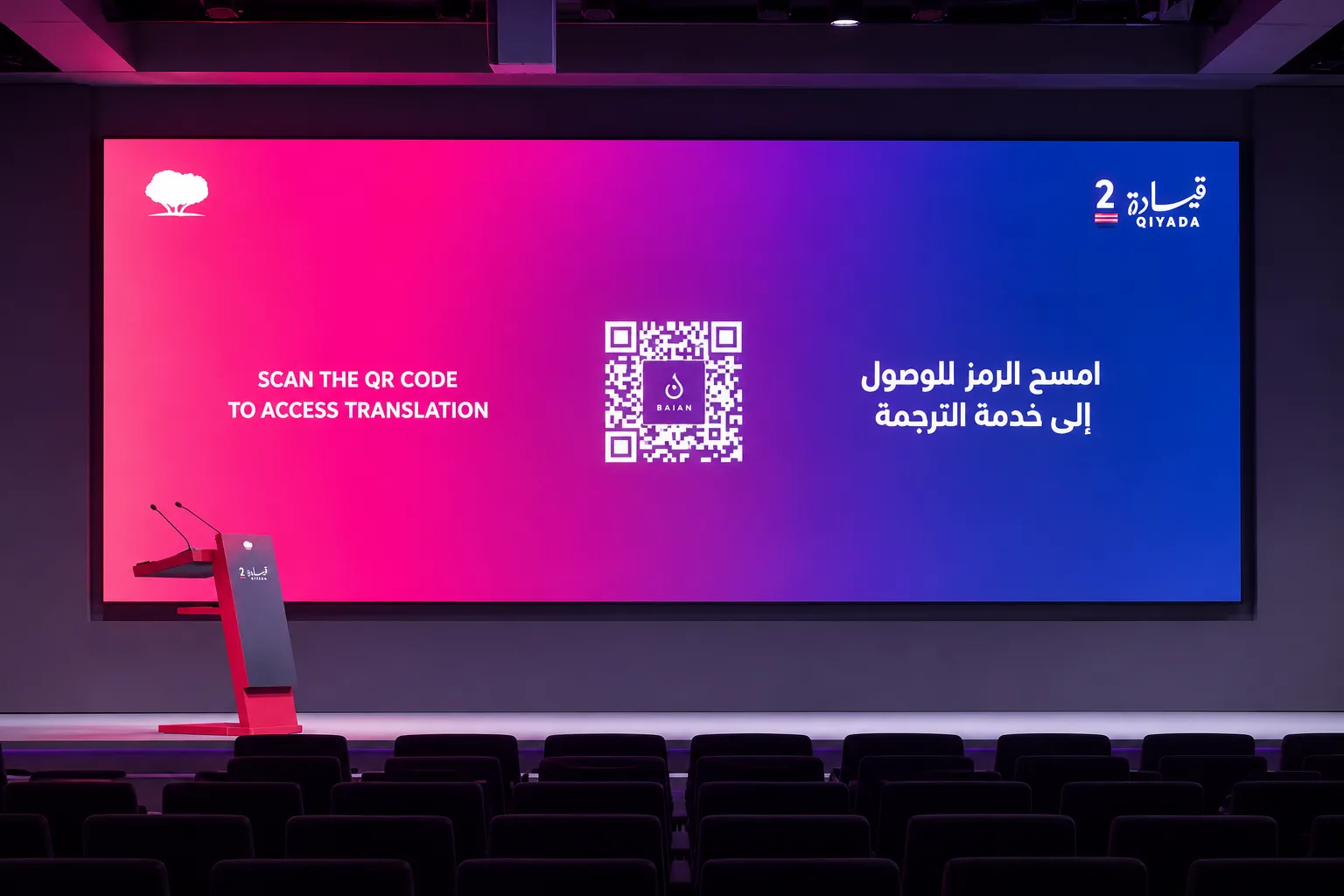
At Qatar Foundation’s QIYADA conference, attendees scanned the code and followed Arabic and English on their own phones. The interpreter booths were taken down.

Dates
25 and 26 Sept 2026
Languages
Arabic, English
Booths
None
Read the story
The QIYADA stage screen showing Baian’s QR code, asking attendees in English and Arabic to scan it for translation

Want to test it with your event?

Tell us your languages, audience size and sound setup. For up to 10,000 listeners at once, we’ll confirm capacity and support before you book.

Discuss your event ↗WhatsApp Explore audience languages →
Sources and methodsChecked 11 October 2026
  • Baian against professional translators (FLoRes)October 2026

    Caption Tool scored above the translators in Hausa, Swahili, Tamil and Urdu (preferred on 67% to 75% of sentences). Baian’s live interpreter had about the same overall quality in Arabic, Hindi and Korean.

  • Live delay13 to 15 October 2026

    Median 2.1 seconds across 53 recordings in 15 languages (1.3 to 2.7 seconds per recording).

  • How quickly words appear13 to 15 October 2026

    Estimated medians: the speaker’s words appear in their own language about 1.0 seconds after they are spoken, and the first translation covering a word about 2.4 seconds after it.

  • European Parliament interpreters2019

    Median 2.69 seconds behind the speaker, across 180 speeches.

  • Interpreters on long turns1998

    About 30 minutes is the recommended turn. Meaning errors rose steadily after 30 minutes on task (pilot study, five professionals).

  • What simultaneous interpreters leave out2024

    Part of the meaning was missing in 350 of 590 speech segments.